OPS
External concrete block walls require careful insulation planning, particularly in colder conditions. Unlike timber-framed walls, concrete blocks have relatively high thermal conductivity and can become very cold in winter. If warm, moisture-laden indoor air reaches the cold wall surface, condensation may form within the wall assembly.
Understanding condensation risk in block walls
Condensation occurs when water vapour in warm air reaches a surface that is below its dew point and changes into liquid water. In an external block wall, this can become a concern when air leaks through gaps in the internal lining or insulation and comes into contact with cold concrete.
If the wall system cannot dry adequately, moisture may build up in the insulation cavity. Over time, persistent moisture can contribute to mould growth, deterioration of internal linings and a reduction in thermal performance.
Why glasswool needs careful wall-system design
Glasswool is an effective thermal insulation material, but it is air-permeable and does not act as a vapour barrier. When it is installed against an external concrete block wall, warm indoor air may be able to move through the insulation if gaps or inadequate air sealing are present.
This does not mean glasswool cannot be used in external block wall systems. It can perform well when the full wall assembly has been appropriately designed. However, insulation placement, air sealing, vapour control, waterproofing and drying potential all need to be considered together.
Benefits of rigid polystyrene insulation
Rigid polystyrene insulation is often preferred for certain external concrete block wall applications because it can provide a more continuous insulating layer and help manage air movement when properly fitted and sealed.
- Reduced air movement: Well-fitted, sealed rigid boards can help limit warm indoor air reaching cold concrete surfaces.
- Moisture resistance: Polystyrene does not absorb moisture in the same way as fibrous insulation, although performance depends on the specific product selected.
- Consistent thermal performance: Correct installation helps create a reliable insulating layer across the wall.
- Improved condensation management: As part of a properly designed system, rigid insulation can help reduce condensation risk.
Rigid insulation is not automatically condensation-proof
Choosing polystyrene alone does not guarantee a condensation-free wall. Incorrect installation, poor sealing or an unsuitable wall design can still lead to moisture problems. The right solution depends on how every component of the wall assembly works together.
For external block walls, insulation should not be selected on R-value and price alone. Considering condensation risk and the wall's overall moisture-management design is essential before choosing a product.
A practical approach for external concrete block walls
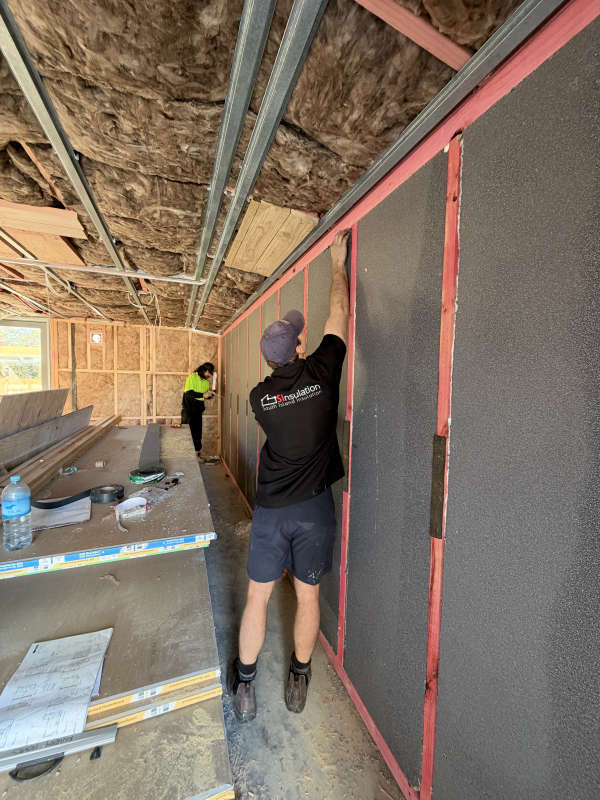
SInsulation supplies and installs rigid polystyrene insulation for external concrete block walls, offering builders a practical, cost-effective insulation option. We work with builders to help ensure the selected insulation product and installation method are suitable for the specified wall system and its thermal requirements.
By considering insulation alongside air sealing, vapour control, waterproofing and drying potential, builders can make more informed decisions for durable, high-performing external block wall systems.